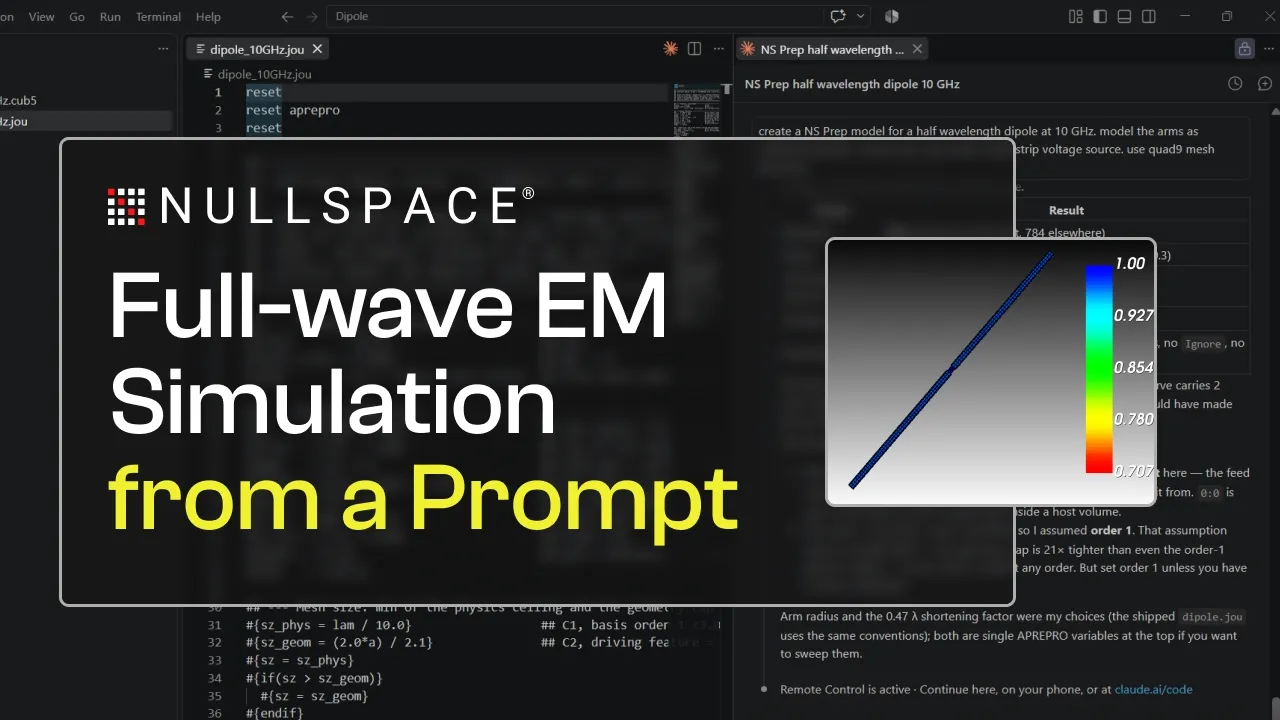
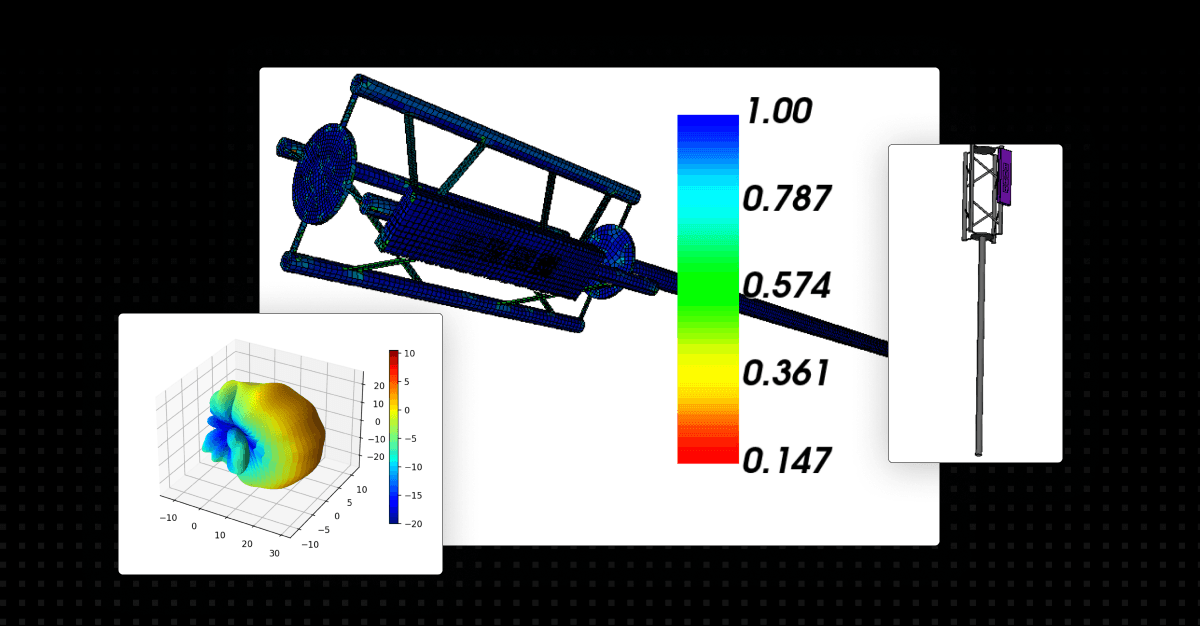
In this first episode of AI With Nullspace, Senior Applications Engineer Ryan Cutshall lays out the framework for how Nullspace works with the LLM tools engineers already use to orchestrate the full simulation pipeline.
Covered in this episode:
Prompt 1 produces a Nullspace Prep journal file for cylindrical dipole arms, a 75 ohm split-strip voltage source, and quad-9 mesh elements, built and verified through a headless run of Prep.
Prompt 2 writes and runs a Nullspace EM simulation from 8 to 12 GHz and plots return loss, a Smith chart, 2D directivity, and 3D gain.
Prompt 3 produces a PDF report with model, feed, and mesh screenshots, mesh quality metrics, solver metrics, the four plots, and conclusions.
We selected the dipole as our first example because it is the ideal control case. Its input impedance and radiation pattern have analytic solutions, so the results can be checked against theory. That verifies two things at once: the accuracy of the numerical code, and whether the agent wrote the right code, ran the right simulation, and reported the right results. Before an agent is trusted with a harder problem, we need to see it get a known one right.
Why this is possible in Nullspace:
Nullspace EM is a full-wave, validated, 3D Method of Moments solver with no asymptotic approximations, developed over 15+ years inside a defense contractor. Every step of the workflow is available through a Python API: geometry and meshing in Nullspace Prep, solve setup, post-processing, and plotting in Nullspace EM. Nullspace's skills files give an AI agent the knowledge it needs to write correct code against that API, which enables LLMs to run the whole pipeline headlessly.
The LLM writes and runs code; but the solver always computes the physics. Results are physics-based, with no hallucinations, because at no point does the AI produce a number on its own.