
Nullspace Prep & EM 2025 R1: AI-Powered CAD Cleanup, Accelerated Wideband Analysis and Enhanced RF System Modeling
Nullspace Inc. is pleased to announce the release of Nullspace Prep & EM 2025 R1, delivering significant advancements in electromagnetic simulation capability for antenna and microwave engineers. This release introduces enhanced CAD cleanup capabilities that streamline the path from mechanical design to RF analysis, Fast Adaptive Frequency Sweeps (FAFS) for dramatic speedups in wideband analysis, and passive circuit load modeling for realistic RF system simulation.
AI-Powered CAD Cleanup
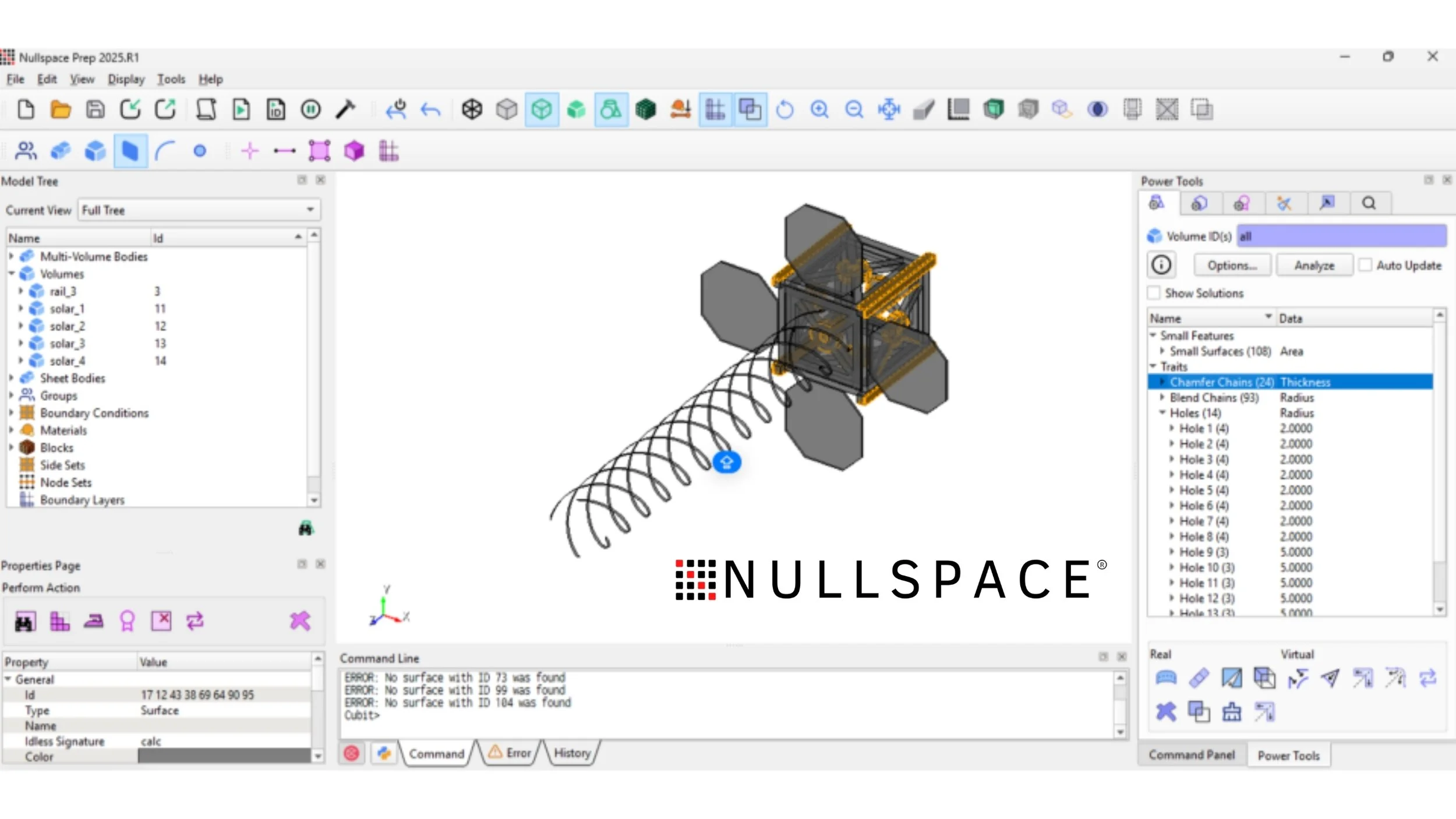
Newest release of Nullspace Prep and EM featuring AI-powered CAD cleanup for easier defeaturing and faster preparation for EM simulations.
Nullspace Prep 2025 R1 delivers substantial enhancements to CAD cleanup capabilities, incorporating AI-based diagnostics and automated defeaturing tools that dramatically reduce the time required to prepare mechanical CAD models for electromagnetic simulation.
CAD files from mechanical design tools frequently contain geometric features that, while essential for manufacturing, have negligible impact on RF performance. Features such as fastener holes, blend radii, chamfers, and small mechanical details can significantly increase mesh density and simulation time without contributing to electromagnetic accuracy. Traditionally, preparing such models required iterative collaboration between RF and mechanical engineering teams, consuming hours or days before simulation could begin.
Key CAD cleanup enhancements include:
AI-Based Feature Identification: Integrated AI algorithms automatically identify common mechanical features including bolts, nuts, pins, fasteners, and other connectors. Engineers can rapidly select and remove entire classes of features with minimal manual intervention.
Size-Based Feature Filtering: Defeaturing operations support size thresholds that preserve electrically relevant features while removing sub-wavelength details. This ensures that geometry simplification does not compromise simulation accuracy.
Comprehensive Geometry Diagnostics: Automated analysis identifies small curves, small surfaces, small volumes, near-tangent angles, holes, blends, chamfers, and assembly issues including gaps, overlaps, and misalignments between parts.
Streamlined RF Engineer Workflow: RF engineers can now perform CAD cleanup directly within Nullspace Prep, eliminating the need for back-and-forth iteration with mechanical engineering teams and external CAD tools.
In real-world testing on a cubesat geometry, the enhanced CAD cleanup workflow reduced preparation time from over 2 hours to just 15 minutes—an 8X improvement that enables RF engineers to begin simulation the same day they receive mechanical CAD data.
Fast Adaptive Frequency Sweeps: Physics-Informed Wideband Analysis
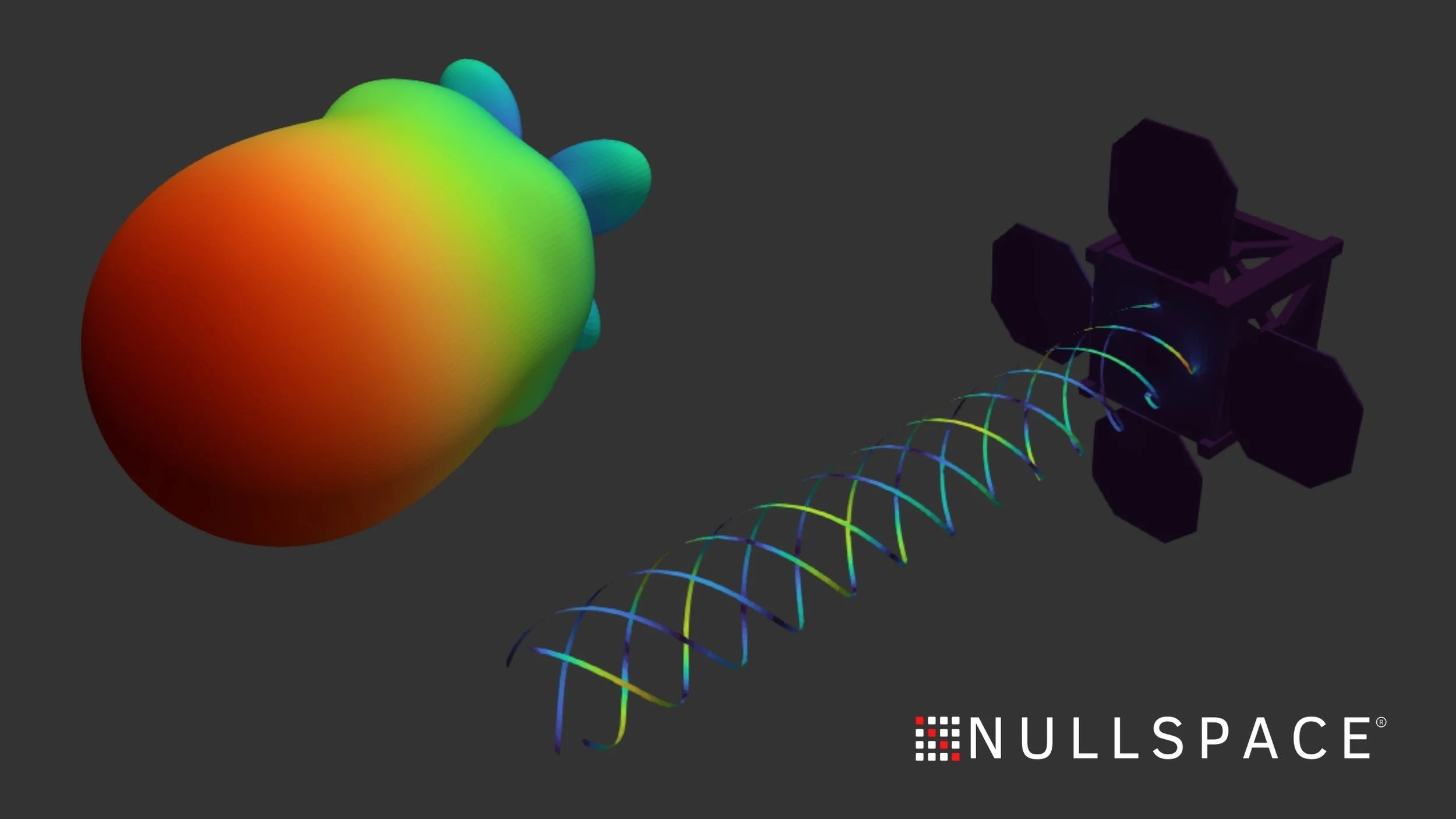
Full fidelity EM simulation results from the newest release of Nullspace EM of a quad helix antenna on a cubesat.
Nullspace EM 2025 R1 is the first commercially available electromagnetic (EM) simulation tool to combine full-fidelity (high-accuracy) EM simulations, a compression algorithm, and Fast Adaptive Frequency Sweeps (FAFS) for up to 100x time savings for accurate, full-fidelity EM simulation results. The new Fast Adaptive Frequency Sweeps (FAFS) feature combines physics-informed interpolation with intelligent sampling to dramatically reduce the computational cost of wideband electromagnetic analysis.
In prior versions of Nullspace EM, engineers were required to manually select frequency sample points across their band of interest. This approach presented two significant challenges: insufficient sampling could miss critical artifacts such as resonances or complex coupling behavior, while conservative oversampling led to excessive computation times. FAFS eliminates this tradeoff by automatically determining optimal sample locations based on the physics of the electromagnetic response.
Key benefits of Fast Adaptive Frequency Sweeps include:
Automated Sample Selection: Users specify only the start and end frequencies; the FAFS algorithm determines optimal sample points using physics-informed interpolation that captures the true frequency-domain behavior of the structure.
Order-of-Magnitude Reduction in Sample Count: In benchmark testing on a multi-resonance antenna, uniform sampling required 1,000 frequency points to adequately resolve the full S-parameter behavior. With FAFS, only 11 adaptively-placed samples were needed to achieve equivalent accuracy—a 90X reduction in required simulation time.
Artifact Detection: The adaptive algorithm concentrates samples in regions of rapid variation, ensuring that narrow- or multi-band features are captured without requiring prior knowledge of their locations.
Reduced Engineering Effort: Engineers no longer need to iteratively refine frequency sampling based on preliminary results, eliminating hours of manual analysis and re-simulation.
FAFS is particularly valuable for applications requiring wideband characterization, including antenna on-body performance analysis, phased array element patterns, and wideband feed network design.
Passive Circuit Loads: Integrated Lumped Element Modeling
Nullspace EM 2025 R1 introduces comprehensive support for passive circuit loads, enabling engineers to incorporate lumped impedance elements directly within full-wave electromagnetic simulations. This capability bridges the gap between circuit-level and field-level analysis, allowing realistic modeling of tightly coupled arrays, loaded scatterers, and tunable RF structures.
The passive circuit load capability supports:
Complex Impedance Specification: Loads may be defined as arbitrary complex impedances, enabling direct modeling of resistive, reactive, and mixed terminations at any frequency.
Frequency-Dependent Impedance Tables: Engineers can specify load impedance as a function of frequency using tabulated data, allowing accurate representation of arbitrary passive networks including measured component data or synthesized filter responses.
Flexible Load Placement: Loads can be applied as port terminations for system-level analysis or as internal lumped elements within the structure for detailed component-level modeling.
Electrically Small Element Assumption: Loads are treated as electrically small elements with a recommended size constraint of less than λ/10, ensuring validity of the lumped element approximation across the simulation band.
This feature enables analysis of advanced RF structures including tunable leaky wave antennas with varactor loading, reconfigurable meta-surfaces, impedance-matched antenna arrays, and terminated traveling-wave structures. Engineers can now perform rapid optimization of impedance matching networks and evaluate system-level performance without requiring separate circuit co-simulation tools.
Practical Impact
These enhancements combine to deliver substantial real-world benefits across the electromagnetic simulation workflow:
10-100X speedup in wideband frequency analysis through Fast Adaptive Frequency Sweeps
Examples of >90X reduction in required frequency samples for multi-resonance structures (1,000 to 11 points in benchmark testing)
Over 8X faster CAD preparation through AI-assisted geometry cleanup (2+ hours to 15 minutes)
Expanded modeling capability for realistic phased arrays, tunable antennas, and loaded RF structures through passive circuit load support
Conclusion
Nullspace Prep & EM 2025 R1 represents a major advancement in electromagnetic simulation capability for antenna and microwave engineers. By introducing AI-powered CAD cleanup, Fast Adaptive Frequency Sweeps, and passive circuit load modeling, this release empowers engineers to analyze larger, more complex RF systems faster than ever before. The combination of streamlined geometry preparation, physics-informed adaptive sampling, and integrated lumped element support makes 2025 R1 an essential tool for all RF designers and analysts.
For detailed information about implementing these new features in your workflow, please refer to the updated User's Guide included with the release.
Email: info@nullspaceinc.com
Website: nullspaceinc.com