



At a Glance
Researcher | Diogo Augusto, MSc in Electrical and Computer Engineering |
Institution | Instituto Superior Técnico, University of Lisbon |
Research group | GROW (Group for Research on Wireless Communications) |
Supervisor | Prof. Luís M. Correia |
Focus | MIMO antenna placement on train rooftops for FRMCS, at 922 MHz and 1905 MHz |
The Challenge

Figure 4.1 – Reference electromagnetic simulation model featuring train roof with antenna positions (Side, Middle, Front).
European railways are preparing to replace GSM-R (the GSM-based radio system European railways have used since the early 2000s) with FRMCS, the Future Railway Mobile Communication System, a 5G-based communication system. The transition puts new antennas on train rooftops that are already occupied with pantographs and HVAC equipment, and it raises a question that has to be answered before installation: where should the antennas go, and how far apart?
The question is harder than it looks. An antenna's datasheet describes how it behaves in isolation. Bolted to a train, it behaves differently: the metal roof reshapes its radiation pattern, and the roof's curvature can block radiation entirely in some directions. FRMCS adds a second layer, because it relies on MIMO (multiple-input multiple-output): two antennas working together, and the arrangement only pays off if the two antennas receive meaningfully different versions of the incoming signal. Place them too close together and the two antennas fade in unison, so the second one adds almost nothing. Put them in the wrong spot and the roof itself degrades their performance.
Testing every candidate position, spacing, and configuration on physical rolling stock is not practical. The placement decision has to be made in simulation.
The study drew on industry perspective from railway communications engineers at Hitachi Rail, and the thesis examination committee included a practicing railway communications engineer from Hitachi Rail.
The Solution: Nullspace EM Simulation
"We had been using another commercial tool, but we were not satisfied with its performance on large structures. Nullspace EM handled these electrically large problems very nicely, and that performance was a key reason we adopted it."
— Prof. Luís M. Correia, GROW Research Group, Instituto Superior Técnico, University of Lisbon
The antenna is simulated as installed. Nullspace EM solved the antenna and the train roof together as one full-wave Method of Moments problem, with no asymptotic approximations. The surface integral equation formulation meshes only the physical surfaces, the antenna and the roof, rather than the volume of space around the train, which is what makes full-wave solves of antennas on large structures tractable. The curved roof itself was represented with high-order geometry, parametric curved surfaces rather than flat facets, reducing discretisation error where the geometry matters most. The roof's ground-plane effect and its curvature shadowing come out of the physics of the solver, not from correction factors applied afterwards.
The entire workflow is scriptable. Geometry was built parametrically through the journal editor in Nullspace Prep; solver configuration and post-processing ran in Python. Every time the model changed, the full study could be re-run: three rooftop positions and three array configurations, each at two frequency bands. The thesis formalizes this as a seven-phase workflow and presents it as a template applicable well beyond this study. (see Figure 3.3)
It ran on the hardware actually available. The thesis notes recommended hardware of 16 or more cores and 64 GB of RAM for this class of simulation. The study ran on a dual-core laptop with 8 GB. Nullspace EM's third-order basis functions and matrix compression reduced the problem size enough to run on that machine. The trade-off was longer simulation times, several hours per run rather than tens of minutes, but it put a full-wave installed-antenna study within reach of a standard consumer laptop.
"I ran full-wave Method of Moments simulations on a dual-core laptop with 8 GB of RAM. The matrix compression and higher-order basis functions made the difference between a study I could run overnight and one I could not run at all."
— Diogo Augusto, MSc, GROW Research Group, Instituto Superior Técnico, University of Lisbon
The Result

Figure 3.3 - Nullspace EM simulation workflow.
Augusto modeled quarter-wavelength monopole elements for each FRMCS band, mounted on a curved train roof section 4 m long and 3 m wide, modeled as a perfect electric conductor. From there, Nullspace EM delivered three things:
Installed radiation patterns. Far-field gain patterns for every antenna, position, and configuration, capturing how the roof modifies each one, exported at 1° angular resolution to feed the correlation analysis.
Placement trades. Direct comparison of front, middle, and side rooftop positions, quantifying where the roof helps and where it hurts.
Configuration comparison. Three dual-element arrangements evaluated at both frequency bands, with each element characterized individually, to identify which one holds up across the full range of conditions.
"Because the whole workflow in Nullspace is scripted, with geometry in the journal editor and the solver and reporting in Python, I could rerun the full study every time the model changed. Comparing three roof positions and three array configurations at two frequencies would not have been practical with manual model setup."
— Diogo Augusto, MSc, MSc, GROW Research Group, Instituto Superior Técnico, University of Lisbon
The far-field patterns, read directly from Nullspace EM's output files, then fed a statistical analysis built in MATLAB, which answered the MIMO half of the question: do the two antennas see sufficiently different signals? The analysis ran 5,000 randomized channel simulations per configuration, covering the environments a train passes through, from multipath-rich stations and cuttings to open track with a strong line of sight. The solver output provides the physical characterization; the statistical layer converts it into MIMO performance predictions.
The Findings

Figure 4.5 – Far-field pattern of horizontal plane for the side position.
The roof turned out to be a significant electromagnetic element in its own right. At the front and middle positions it acts as a ground plane and improves radiation performance. At the side position, the roof's curvature blocks radiation toward one side of the track: mean gain drops by 1.83 dBi at 922.2 MHz and 2.58 dBi at 1905 MHz compared to the antenna without the roof. The result makes placement an electromagnetic design question, not just a mechanical one.
The correlation analysis converted the patterns into a spacing rule, and the thesis condenses everything into a deployment guideline:
Configuration | Symmetric-high dual-element pair, rooftop longitudinal centerline |
Element separation | 32.5 cm (one wavelength at 922.2 MHz; covers both bands) |
Envelope correlation | Below 0.05 in every railway scenario studied |
MIMO system gain | 2.98 to 3.00 dB of the 3.01 dB theoretical maximum, including worst-case line-of-sight conditions |
Rooftop footprint | 0.74 m × 0.10 m |
Clearances | ≥ 4.0 m from pantograph, ≥ 2.0 m from HVAC equipment |
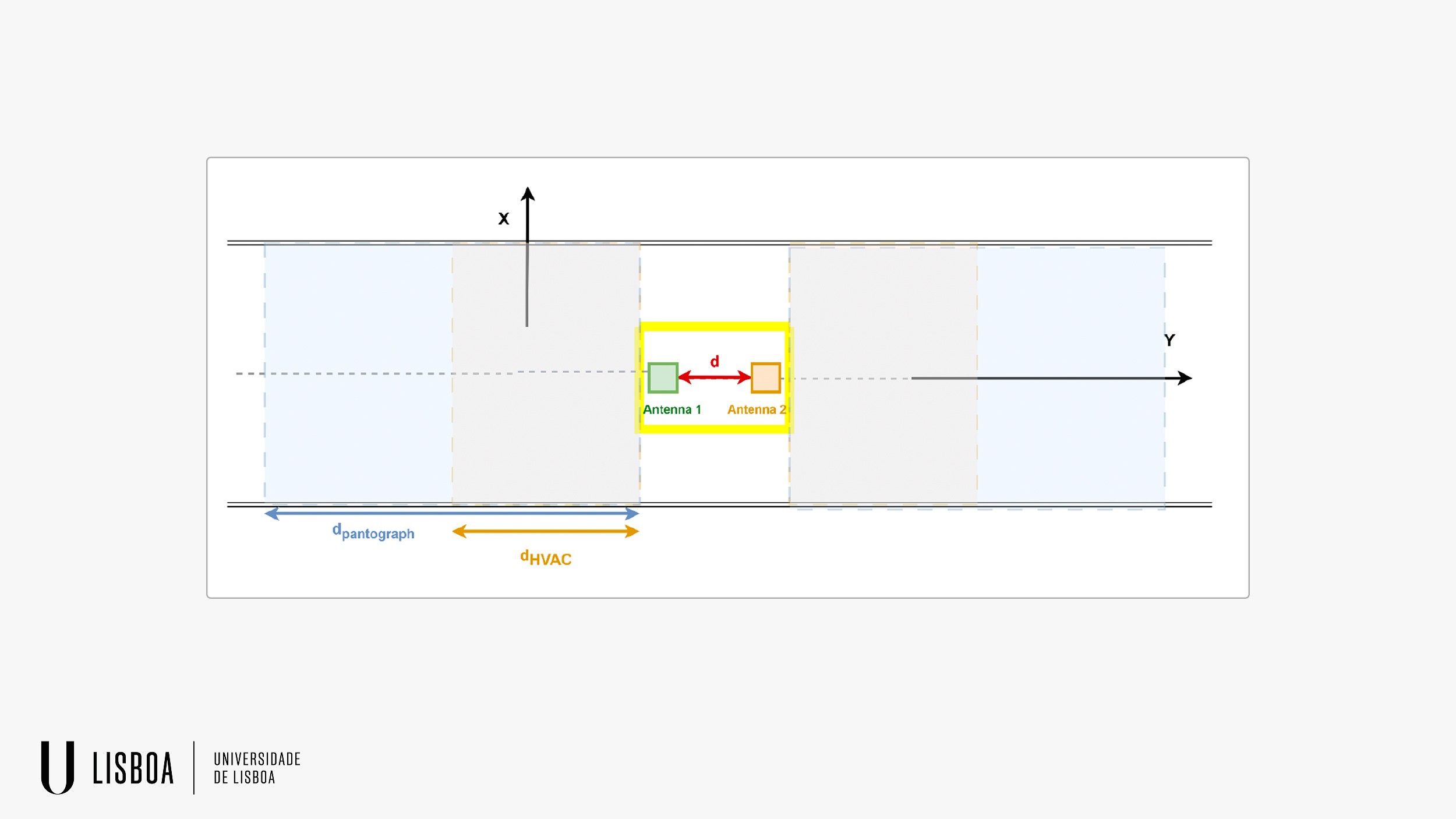
Figure 4.21 – Train roof layout with MIMO system antenna implementation.
With the recommended arrangement, the two antennas receive nearly independent signals in every environment studied, and the MIMO system delivers almost all of its theoretical benefits. The results are simulation-derived for a simplified roof geometry, and validating them on physical rolling stock is the thesis's stated next step. The question from the outset, where the antennas go and how far apart, has a quantified answer before any hardware exists.
What's Next
The more transferable result is the workflow itself. Replace the train roof with an airframe, a mast, a vehicle hull, or a spacecraft bus, and the problem is structurally identical: installed antenna performance, platform effects, element coupling, and placement trade-offs. The seven-phase workflow, parametric geometry, scripted full-wave solves, and far-field data feeding downstream system analysis, applies unchanged. Rail is one instance of a question every platform integrator has to answer.
"This will not be the last of this work in our group; we have further projects underway with new students and new industry partners. And the railway recommendations are no longer only academic. There is industry interest in taking them to trials on actual trains, and we hope to be involved when that happens."
— Prof. Luís M. Correia, GROW Research Group, Instituto Superior Técnico, University of Lisbon
AI Scripted Workflows with Nullspace
The same scriptability points toward where simulation workflows are heading. Every step of this study, from geometry through solve to post-processing, ran as code, and that is the property that makes a workflow AI-drivable. Nullspace EM already runs full-wave simulations from natural-language prompts, with an LLM driving the same Python interface an engineer scripts by hand. The solver supplies the physics; what drives it is increasingly a matter of choice.
About the Nullspace Academic Program
The Nullspace Academic Program provides discounted licenses for Nullspace EM and Nullspace Prep to universities, research institutes, and graduate students, with the full Python API and no feature restrictions. Program members get direct access to the Nullspace engineering team and User Forum, collaborate on research, and help shape the development of the software. In return, members share their work through case studies, papers, or webinars, which is how this article came to exist.
"Nullspace's technical support team was really responsive, their helpfulness was essential at several critical stages of the electromagnetic analysis."
— Diogo Augusto, MSc, GROW Research Group, Instituto Superior Técnico, University of Lisbon
Researchers and students can apply here.
About Nullspace
Nullspace is redefining electromagnetic simulation for the next generation of mission-critical engineering. The company develops full-fidelity, high-speed simulation software purpose-built for RF systems and quantum computing. Built on over a decade of defense-validated technology, its solvers deliver breakthrough performance, enabling engineers to model larger, more complex designs than ever before without sacrificing accuracy. Because Nullspace is Python-native, AI agents can run it end to end: customers can orchestrate complex optimization workflows with the LLM of their choice, on their own infrastructure. Nullspace solutions power innovation in aerospace, defense, 5G, spectrum management, and emerging quantum architectures. For more information, visit www.nullspaceinc.com.
—
Figures 4.1, 3.3, 4.5, 4.21 reproduced from D. Augusto, MSc Thesis, Instituto Superior Técnico, 2026, with permission. Workflow and deployment diagrams adapted from the same work.


